SELF-HOSTED · AI-READY

Free, self-hosted personal finance app

Moat Finance is a personal finance platform you run yourself, for free. Budgeting, investments, retirement planning, and an MCP server for your AI assistant — on hardware you control.

View on GitHub Free forever — clone it, fork it, run it anywhere
Try the demo

Public source code · Docker or Vercel · Your own database · Read-only bank connections · No vendor lock-in

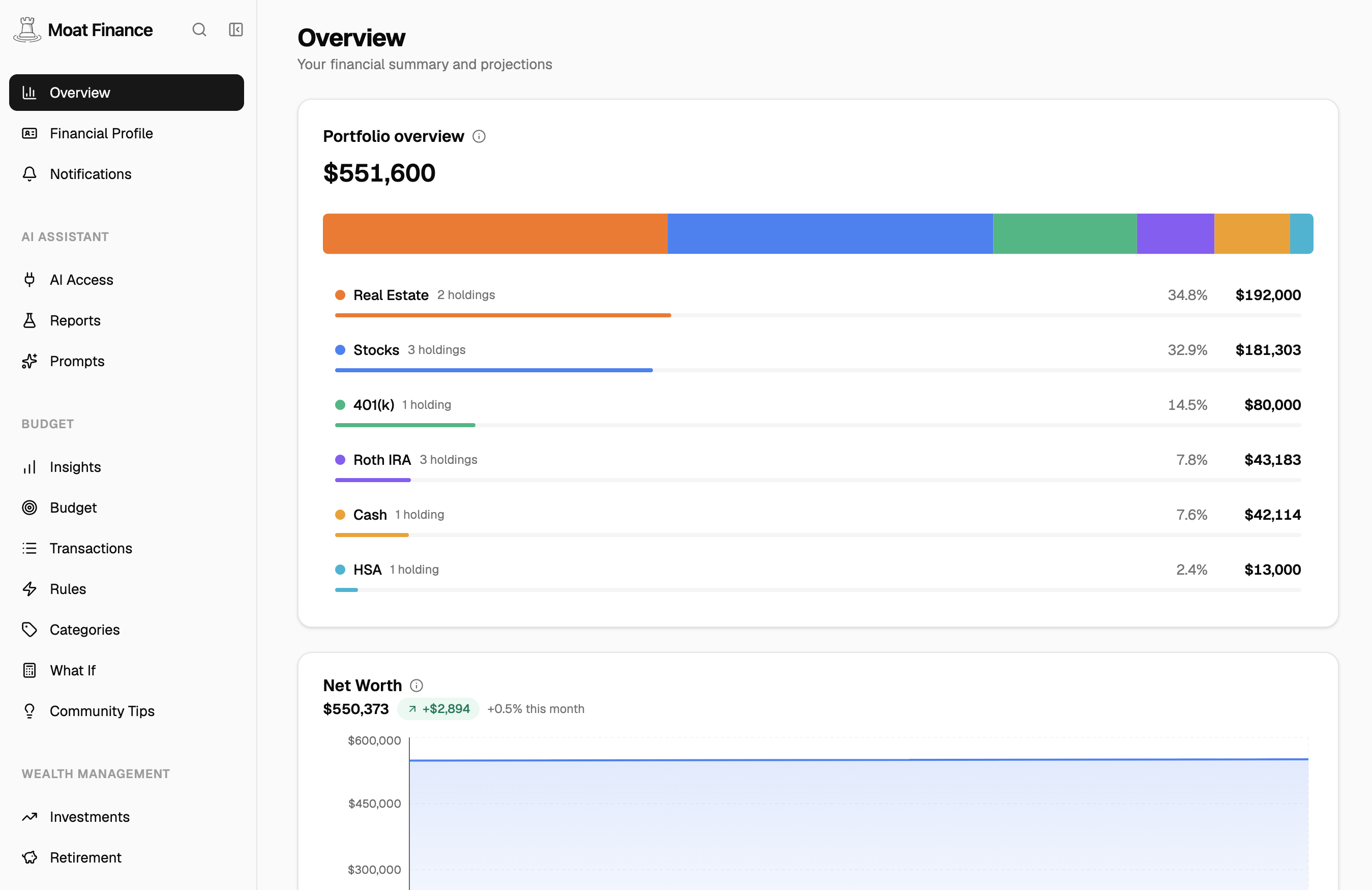
Moat Finance overview with portfolio allocation and net worth
FIRST THINGS FIRST

The three questions everyone asks

What does it actually do?

A complete personal finance platform you own end to end.

  • Budgeting Spending, categories, and a rules engine that gets smarter over time
  • Wealth management Accounts, investments, and the full net-worth picture in one place
  • Retirement planning Projections from your real numbers, not generic advice
  • Your own MCP server Let Claude, ChatGPT, or any MCP client query your finances — through an endpoint you host

A demo is worth 1,000 bullet points. Click around before you deploy anything.

Try the demo
GET STARTED

Run it yourself.
Free forever.

Your data stays on infrastructure you control and it costs nothing. Run it with Docker on a server you own, or free in the cloud on Vercel + Neon.

Need a hand?

Want us to host it?

Join the hosted waitlist

Moat is built to be self-hosted, and that’s still the recommended path. If you’d rather not run it yourself, a hosted version may be offered for $15/month. Email us to join the waitlist.

  • Setup questions and troubleshooting
  • Hosted version may be offered for $15/month
  • Bugs and ideas are best as GitHub issues
QUICKSTART

Two ways to self-host

Docker is the easiest: one machine, one config file, three commands. Vercel + Neon is free in the cloud, with a bit more setup and your own domain. Anything that runs Node.js and Postgres works too.

A

Docker Easiest

One machine, one config file, three commands.

# 1. Get the code
$ git clone https://github.com/tyler16smith/moat-finance.git
$ cd moat-finance

# 2. Configure (generates secrets, fill in optional keys)
$ cp .env.self-host.example .env
$ ./scripts/self-host/generate-secrets.sh

# 3. Launch
$ docker compose up -d

# Open http://localhost:3000
B

Vercel + Neon Free cloud

Vercel’s Hobby plan and a free 500 MB Neon database. Needs your own domain, about $10/year.

  1. Fork the repo and create a Neon database Generate your secrets and run the migrations against it.
  2. Create three Vercel projects Web app, API, and MCP server, all from your fork.
  3. Add your domains and deploy Pushes to your fork redeploy automatically. Step-by-step guide
Either way
  • Bring your own keys, or none Manual accounts and CSV imports work out of the box. Add your own Plaid keys when you want live bank syncing.
  • Connect your AI assistant Point Claude, ChatGPT, or Cursor at your MCP endpoint and create a scoped access token.
  • Want the iPhone app? Build it with your Apple Developer account and install it through TestFlight. iOS setup
THE MISSING PIECE

AI assistants are only as useful as the context they can access.

The problem

Your AI assistant can reason, calculate, and explain tradeoffs. But it can’t give truly useful financial advice without understanding your actual financial life.

Getting that context today means handing your most sensitive data to yet another closed SaaS company and hoping they handle it well.

The solution

Moat Finance gives you a complete, structured financial profile that lives on your own infrastructure — usable by you, your apps, and your AI assistant.

Your agent reasons from your real income, spending, investments, insurance, debt, and goals. The data never leaves your control.

You host the data. Your agent gives you the insight.

FULL FINANCIAL PROFILE

More than budgeting

Every feature ships in the self-hosted build. No enterprise edition, no locked tiers.

Bank AccountsChecking, savings, cash
Credit CardsBalances, limits, utilization
InvestmentsStocks, ETFs, portfolios
Cash FlowIncome, expenses, trends
BudgetsCategories, targets, tracking
TransactionsCategorized, tagged, searchable
Real EstateProperties, mortgages, equity
Retirement401(k), IRA, Roth, projections
Rules EngineAuto-categorize, tag, organize
Tax TagsFlag deductibles, prep for filing
Life InsuranceCoverage, premiums, beneficiaries
Health InsurancePlans, HSA, deductibles, benefits
ForecastsNet worth, cash flow projections
HouseholdFamily context, shared finances
Self-hosted MCPYour endpoint, scoped tokens
Financial GoalsTargets, milestones, progress
AI ReportsPersistent, shareable AI insights
REST APIOpenAPI spec included
AI ASSISTANT INTEGRATION

Give your agent
real financial context

Most AI financial advice is generic because the agent doesn’t know your real financial life. Moat changes that without shipping your data to a third party.

Your Moat instance exposes your accounts, transactions, budgets, investments, insurance, debt, goals, and forecasts through an MCP server you host. Issue scoped tokens, review every call in the audit log, and revoke access anytime.

Powered by MCP — Model Context Protocol
Ask your agent:
?"Can I afford to buy a house next year?"
?"Am I saving enough for retirement?"
?"Which subscriptions should I cancel?"
?"Should I choose the HSA plan or the lower-deductible PPO?"
?"How much cash should I keep with my income volatility?"
?"What will my net worth look like in 10 years if I increase retirement contributions by 3%?"
RULES ENGINE

Built for people
who want control

If you self-host, you probably like things exactly the way you like them. Moat’s rules engine keeps your data clean without manual cleanup.

Create rules that automatically categorize transactions, tag expenses, flag tax-related spending, and keep your budget accurate.

The more rules you create, the smarter your financial profile becomes.

Example rules
IF merchant contains "Netflix"
THEN categorize as Subscriptions
IF merchant contains "restaurant" or "dining"
THEN tag as Business meal for tax review
IF amount > $1,000 and type is income
THEN categorize as Salary
IF merchant contains "charity" or "donation"
THEN tag as Charitable donation for tax season
HOW MOAT FINANCE COMPARES

Own the whole stack

How self-hosted Moat stacks up against closed personal finance apps and building your own.

Feature Moat Finance Monarch YNAB ChatGPT Build Your Own
Public source codeYesNoNoNoYes
Self-hostableYesNoNoNoYes
You own the databaseYesNoNoNoYes
Free to useYesNoNoNoYour time
BudgetingYesYesYesYesIf built
Net worth & investmentsYesYesLimitedYesIf built
Rules-based transaction systemYesPartialCategory rulesLimitedIf built
Insurance & HSA contextYesNot coreNot coreNot coreIf built
Self-hosted MCP serverYesNoNoNoIf built
Read-only account connectionsYesYesYesYesDepends

Competitor features can change. This comparison reflects publicly available information at the time of writing.

Could you build this yourself? Yes. Now you don’t have to.

With AI today you could build your own finance app: wire up Plaid, design a schema, build a rules engine, add forecasting, write an MCP server, and handle encryption. Or you could fork a codebase that already does all of it.

Build from scratch Weeks of development, AI tokens, security decisions, and ongoing maintenance — all on you
vs
Fork Moat Finance Already built and maintained in the open. Customize what you want, upstream what you think others need.
SECURITY

Privacy you can verify

Closed apps ask you to trust them. Public source code lets you check.

Server

Self-hosted server

  • Data stays in a database you run
  • Sensitive fields encrypted with keys you hold
  • Optional two-factor authentication
  • Read-only bank connections via your Plaid keys
  • Scoped MCP tokens with a full audit log
  • Product analytics off unless you configure it
ABOUT MOAT FINANCE

Why I built this

Moat Finance started because I was frustrated with my budgeting app.

I wanted better rules. I wanted cleaner transactions. I wanted a system that could help me prepare for tax season instead of leaving me with a pile of uncategorized financial history at the end of the year.

Then AI assistants started getting useful.

I realized the missing piece wasn’t another chatbot. It was the financial context behind the chatbot. An agent can answer generic questions without your data. But it can’t help you make deeply personal financial decisions unless it understands your actual financial life.

The goal isn’t to replace your judgment. The goal is to give you better context.

But the more context an agent needs, the more you’re asked to trust whoever holds it. Your income, your debt, your insurance, your family’s plans — that shouldn’t live on a server you can’t inspect, run by a company that can change its pricing or shut down.

And charging almost $15/month to someone with one or two accounts always felt wrong to me.

So Moat Finance is free. Free to self-host, with all of its source code public. Run it yourself. Read every line. Fork it if you want it to work differently.

Financial clarity should be private, intelligent, and owned by you.
Get involved:
Built in the open. Owned by its users.

Your money. Your server.
Your agent’s context.

Clone the repo, run one command, and own your financial data for good.

View on GitHub Free to self-host
Try the demo

Free · Self-hosted · AI-ready

Questions? hello@moatfinance.ai